

Top.Mail.Ru
empty
 
 
30.06.2026 10:09 AM
Oil Completes the Quarter with the Largest Drop Since the Pandemic

Oil finishes the quarter with the largest decline since the pandemic began. Nearby Brent futures have fallen nearly a third over three months, marking the steepest quarterly drop since 2020. More active September contracts are trading above $73 per barrel, while WTI has approached $70 per barrel. The reasons remain the same and are intensifying. The flow of oil through the Strait of Hormuz has accelerated following progress in the peace agreement, and Morgan Stanley is already warning of a potential oversupply.

This image is no longer relevant

The physical normalization of traffic is progressing faster than expected, as the figures confirm. According to Morgan Stanley, 35 oil and gas tankers passed through the strait on Thursday. This is the first instance of the number of vessels returning to the typical pre-war range of 30-40 units. Five very large tankers and one Suezmax have already entered the Persian Gulf with the potential to export about 11 million barrels. Movement slowed over the weekend after the escalation and Iranian attacks on vessels, but then it recovered.

Morgan Stanley's new forecast is concerning for bulls. To create an oversupply, it is enough for flows to recover to just 65 percent of the pre-war level, and the bank has already cut its price forecast for the next quarter by one-sixth.

The diplomatic backdrop remains contradictory. The US states that negotiations will start on Tuesday in Doha, while Iran's Foreign Ministry announced it would send only a delegation of experts and ruled out direct negotiations. Control over the strait remains the main sticking point.

Nevertheless, the market prefers to trade on declines, and psychology is important here. Markets move on short-term sentiment, and the optimism surrounding the sharp improvement in traffic through the strait encourages many speculative traders to take short positions in anticipation of further declines in oil prices. In other words, speculative pressure is added to the fundamental factor of supply recovery, which increases the downward movement.

For the global economy, the collapse in oil prices remains a key disinflationary factor. The drop in Brent from its war peak above $100 to current levels around $73 directly reduces inflationary pressure, which is already reflected in price data and central bank rhetoric. Upcoming negotiations in Doha will show whether the de-escalation will hold or if the conflict over the strait's future management will return a geopolitical premium to oil.

This image is no longer relevant

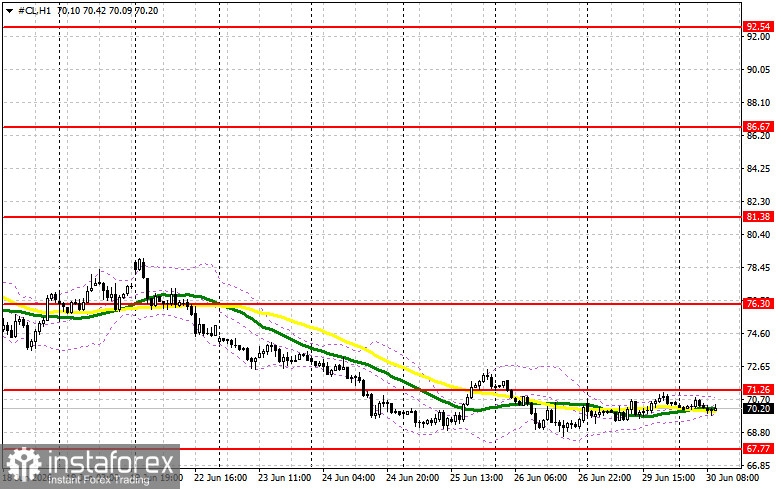
From a technical standpoint, buyers need to reclaim the nearest resistance at $71.25. This would allow targeting $76.30, above which it will be quite challenging to break through. The furthest target will be around $81.38. In the event of a decline in oil, bears will attempt to take control of $67.77. If they succeed, breaking this range will deal a serious blow to bull positions, pushing oil down to a low of $59.96 and potentially reaching $51.99.

Miroslaw Bawulski,
Analytical expert of InstaForex
© 2007-2026
Summary
Urgency
Analytic
Maxim Magdalinin
Start trade
Earn on cryptocurrency rate changes with InstaForex
Download MetaTrader 4 and open your first trade
  • Grand Choice
    Contest by
    InstaForex
    InstaForex always strives to help you
    fulfill your biggest dreams.
    JOIN CONTEST
  • Chancy Deposit
    Deposit your account with $3,000 and get $1000 more!
    In June we raffle $1000 within the Chancy Deposit campaign!
    Get a chance to win by depositing $3,000 to a trading account. Having fulfilled this condition, you become a campaign participant.
    JOIN CONTEST
  • Trade Wise, Win Device
    Top up your account with at least $500, sign up for the contest, and get a chance to win mobile devices.
    JOIN CONTEST
  • 30% Bonus
    Receive a 30% bonus every time you top up your account
    GET BONUS

Recommended Stories

Can't speak right now?
Ask your question in the chat.
Widget callback