Analysis of Trades and Trading Tips for the Japanese Yen
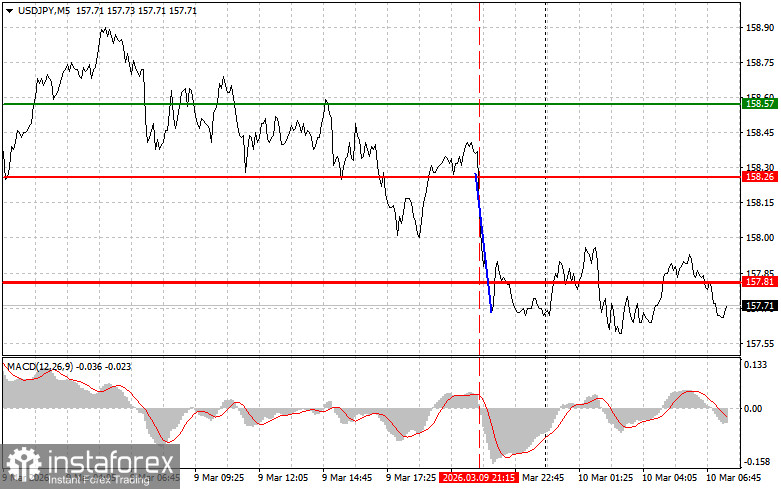
The price test at 158.26 occurred when the MACD indicator was just starting to move down from the zero mark, confirming the correct entry point for selling dollars. As a result, the pair decreased to the target level of 157.81.
U.S. President Donald Trump's statements regarding the imminent resolution of the potential military conflict with Iran seemingly had a dual impact on the markets. On the one hand, a decrease in geopolitical tensions typically leads to a weakening of safe-haven assets like the U.S. dollar, as investors shift to riskier instruments. On the other hand, these same statements can be interpreted as a factor that promotes stability in commodity markets, potentially easing inflationary pressure and thereby supporting consumer demand in several countries.
Against this backdrop, the emergence of genuinely strong data regarding Japan's GDP growth became perhaps a more significant catalyst for certain currency pairs. Indicators showing a recovery in the Japanese economy typically enhance the attractiveness of the Japanese yen, which led to its strengthening during today's Asian trading session. The combination of reduced geopolitical risks that undermine the dollar's attractiveness and positive Japanese economic data is likely to contribute to further declines in USD/JPY in the short term; however, the long-term bullish market for this trading instrument is far from over.
As for the intraday strategy, I will focus more on implementing Scenarios No. 1 and No. 2.
Buying Scenarios
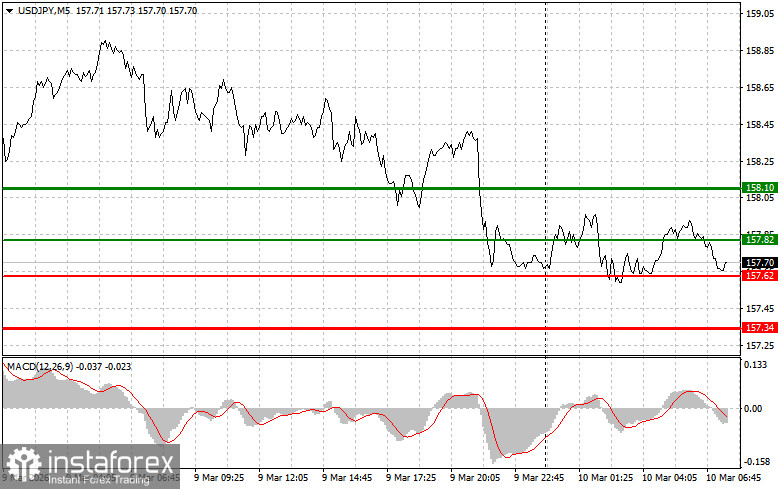
Scenario No. 1: Today, I plan to buy USD/JPY at around 157.82 (green line on the chart), targeting a move to 158.10 (thicker green line on the chart). At around 158.10, I plan to exit my long positions and open shorts in the opposite direction (expecting a movement of 30-35 pips from the entry point). It is best to resume buying the pair on corrections and significant pullbacks in USD/JPY. Important! Before buying, ensure the MACD indicator is above the zero mark and just starting to rise from it.
Scenario No. 2: I also plan to buy USD/JPY today in the event of two consecutive tests of the price at 157.62 when the MACD indicator is in the oversold area. This will limit the pair's downward potential and lead to an upward market reversal. An increase towards the opposite levels of 157.82 and 158.10 can be expected.
Selling Scenarios
Scenario No. 1: I plan to sell USD/JPY today only after breaking the level of 157.62 (red line on the chart), which will lead to a rapid decline of the pair. The key target for sellers will be the 157.34 level, where I plan to exit my shorts and immediately buy in the opposite direction (expecting a move of 20-25 pips from the level). It is better to sell as high as possible. Important! Before selling, ensure the MACD indicator is below the zero mark and just starting to decline from it.
Scenario No. 2: I also plan to sell USD/JPY today in the event of two consecutive tests of the price at 157.82 when the MACD indicator is in the overbought area. This will limit the upward potential of the pair and lead to a market reversal downward. A decline towards the opposite levels of 157.62 and 157.34 can be expected.
What's on the Chart:
- The thin green line represents the entry price at which you can buy the trading instrument;
- The thick green line is the assumed price where you can set Take Profit or manually take profit, as further growth above this level is unlikely;
- The thin red line indicates the entry price at which you can sell the trading instrument;
- The thick red line is the assumed price where you can set Take Profit or manually take profit, as further decline below this level is unlikely;
- The MACD indicator. When entering the market, it's important to refer to the overbought and oversold zones.
Important: Beginner traders in the forex market need to make entry decisions very carefully. It is best to stay out of the market before the release of important fundamental reports to avoid sharp fluctuations in prices. If you choose to trade during the release of news, always set Stop Loss orders to minimize losses. Without placing Stop Loss orders, you can quickly lose your entire deposit, especially if you do not use money management and trade large volumes.
And remember, successful trading requires a clear trading plan, like the one presented above. Making spontaneous trading decisions based on the current market situation is inherently a losing strategy for intraday traders.