


MobileTrader
MobileTrader: platform dagangan di hujung jari!
Muat turun dan mulakan sekarang!

 20.03.2026 02:18 PM
Today's roundup examines four interlinked developments:
– geopolitical tensions around Iran pushed up oil prices and prompted outflows from Asian currencies, while the dollar weakened amid mixed central bank signals;
– rising inflation and a hawkish Fed tone weighed on gold and silver;
– the tech sector shows strength: Apple monetises AI subscriptions, while Microsoft expands access to AI tools.
These developments map the risks and opportunities investors face, from commodity and FX moves to new growth points in AI. If you intend to extract profit from this market environment, your job is to study and analyze new opportunities, design a trading strategy, and, accounting for all risks, start executing it.
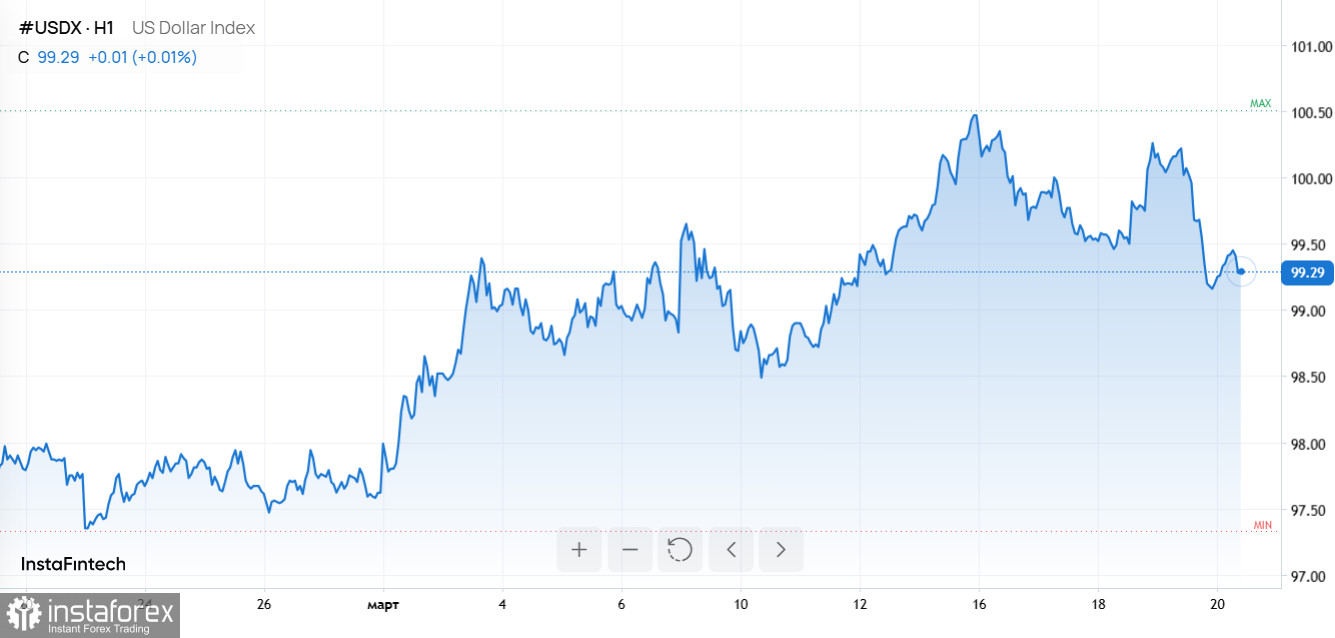
On Friday, most Asian currencies weakened and the dollar eased as investors weighed the economic impact of higher oil following the US and Israeli actions against Iran.
Heightened energy security risks and hawkish signals from major central banks forced investors to reprice rate expectations and reposition FX exposures.
The dollar, which had rallied to multi-month highs earlier in the week, entered Asian trade on the back foot and is heading for its first weekly decline in three weeks.
The US dollar index and futures rose about 0.2% each in Asian trade but are down about 0.8% for the week.
Although the dollar had benefited earlier from reduced expectations of Fed easing this year, it underperformed a number of developed-market currencies.
The Fed left interest rates unchanged on Wednesday and highlighted rising uncertainty around oil-driven inflation, while giving no hint of imminent tightening.
That contrasted sharply with firmer commentary from the Bank of Japan, the ECB, the Swiss National Bank, and the Bank of England.
The yen retained part of its gains after the BOJ comments, while the euro, franc, and pound are set for weekly gains. The Australian dollar also strengthened after the RBA lifted interest ates and warned of further action if rising oil prices keep pushing inflation up.
On Friday, most Asian currencies weakened, ending the week slightly lower as investors worried about oil price consequences.
Asian economies — notably India, South Korea, and Japan — are seen as most vulnerable to supply disruptions because they import the majority of their energy.
The Indian rupee posted another record weekly low: USD/INR stayed around the 93 mark and rose about 0.4% on the day. USD/KRW (South Korean won) reached levels not seen since 2009, rising about 0.5% over the week.
Iran is widely believed to be effectively blocking the Strait of Hormuz in response to strikes by the United States and Israel. That waterway is a key route for oil and gas deliveries to Asia, amplifying market concern.
The Chinese yuan has been among the more resilient regional currencies: USD/CNY was effectively flat for the week. The People's Bank of China left its benchmark lending rate unchanged on Friday and the currency barely reacted.
Analysts note China is relatively better positioned for oil and gas supply shocks because of large strategic reserves and limited dependence on gas for power generation.
The instruments mentioned are available on the InstaForex platform. To exploit market opportunities, traders should open an InstaForex account and, for convenience, download the MobileTrader app to react quickly to news and manage positions in real time.
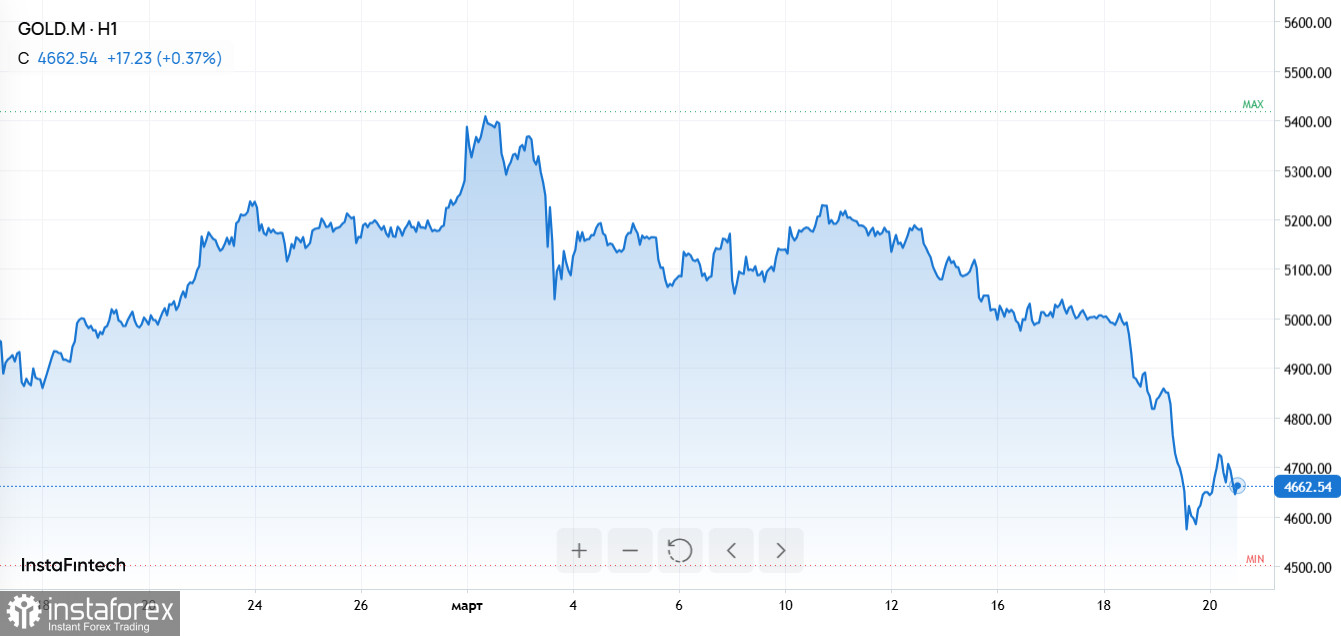
On Thursday, gold and silver plunged sharply after oil prices jumped amid an escalation in the US-Iran conflict and concurrently hawkish Federal Reserve rhetoric. The move produced the largest decline in precious metals in weeks and effectively wiped out the risk premium gold and silver had built as safe havens during the Middle East crisis.
Spot gold collapsed about 6.6% to $4,575.60/oz, hitting its lowest level since early February, according to the Associated Press. Silver lost nearly 12%, dropping below $66/oz — the weakest since late December and more than 45% off its January peak of $121.65. For gold, this marked a seventh consecutive down session, the longest losing streak since 2023.
The reversal began after the Fed meeting, where the central bank left its policy range at 3.5%–3.75% but delivered a firmer signal on the future path. The closely watched dot plot showed seven of 19 policymakers now expect no rate cuts in 2026 — more than in December's projections — and the median forecast was trimmed to a single cut this year.
Fed Chair Jerome Powell noted that the economic fallout from the Iran war remains "uncertain" and stressed that any rate reduction will depend on progress on inflation. Officials raised their inflation forecast for 2026 to 2.7% from 2.4% in December, citing the impact of higher energy prices and persistent inflationary pressures, including those related to tariffs.
Paradoxically, geopolitical risk — which normally supports demand for gold as a safe haven — in this instance triggered an oil shock that intensified inflation concerns and strengthened expectations that rates will remain elevated. On Thursday, Brent briefly topped $119/bbl before pulling back, while the US benchmark held near $97/bbl.
Don't forget risk management: use stop-loss orders, size positions to account for elevated volatility, and be mindful of liquidity risk.

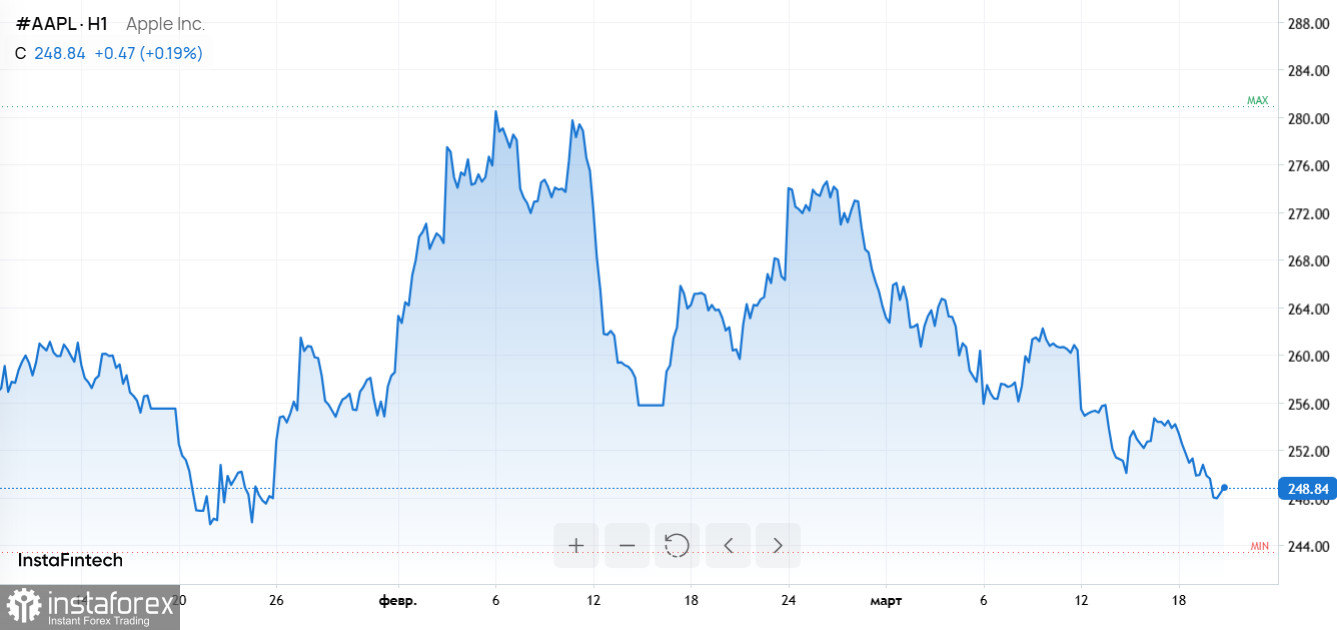
Apple could top $1bn in AI-related revenue in 2026 — but that income is driven not by its own AI projects but by App Store commissions on subscriptions to third-party generative AI apps.
According to The Wall Street Journal and AppMagic analysts, the fast-growing services segment is already generating material profit for Apple and reinforcing its role as a "toll road" for AI providers.
AppMagic's research shows generative AI apps delivered nearly $900m in App Store commissions to Apple in 2025. Three-quarters of that haul came from ChatGPT, while xAI's Grok ranked second with roughly a 5% share of the flows.
The App Store monetization model charges up to 30% of subscription fees in an app's first year and 15% thereafter, with local rates varying across jurisdictions.
Apple's monthly revenue from generative-AI apps surged from roughly $35m in January 2025 to a peak of $101m in August that year, per AppMagic. Revenues eased as downloads of ChatGPT cooled, yet the category remains a meaningful contributor to Apple's services mix.
Against the backdrop of total company revenue of $416.2bn in fiscal 2025, $1bn is still a small slice — but it lands in a high-margin, fast-growing part of the business.Charles Reinhart, chief investment officer at Johnson Asset Management, told The Wall Street Journal that if Apple can serve as the paid highway for AI providers, it is likely to benefit over the long term without major capital expenditure.
Unlike many peers investing hundreds of billions in chips and datacentres, Apple has avoided heavy infrastructure spending and does not operate a cloud business that would need to soak up excess compute capacity.
Apple's strategy turns the App Store ecosystem into a profit-collection mechanism for third-party technology. Even if individual AI apps lose peak popularity, the commission structure and the scale of the iPhone audience provide a predictable revenue stream.That makes Apple's services segment more predictable and attractive to investors who value steady subscription revenues in addition to device sales.
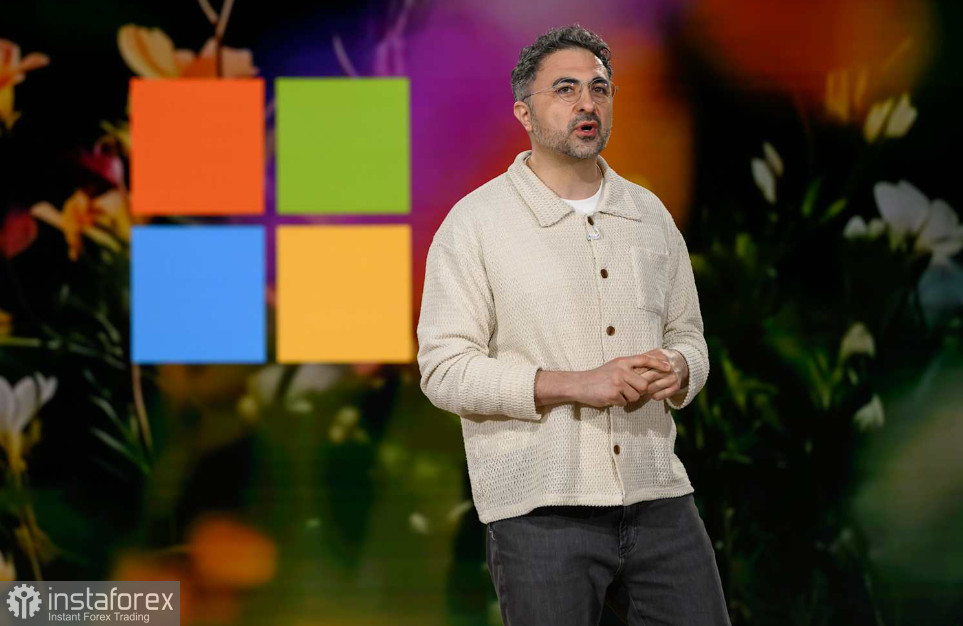
On Thursday, Microsoft unveiled MAI-Image-2, a second-generation text-to-image model. The model is already being integrated into Copilot and Bing Image Creator, is available in the MAI Playground and will soon be opened to developers via Microsoft Foundry.
According to crowdsourced rankings at Arena.ai, this move has pushed Microsoft into the top three labs for AI image-generation.
MAI-Image-2 was developed by the Microsoft AI Superintelligence team led by Mustafa Suleyman. Microsoft says the model can produce a wide range of images — from photorealistic scenes to detailed infographics — with a focus on natural lighting and accurate skin-tone rendering.
Microsoft also highlights improved reliability when rendering text inside images, useful for posters, infographics, and charts. CEO Satya Nadella wrote on X that the model is "already available in MAI Playground for everything from photorealistic images to detailed infographics."
On Arena.ai's model-by-model ranking, MAI-Image-2 currently sits fifth, but Microsoft claims third place in the "model-family" category, behind Google and OpenAI's GPT-Image-1.5. That is a marked step up from MAI-Image-1, which debuted at ninth place when it launched in October 2025.
API access to MAI-Image-2 is already open to select enterprise clients, including advertising giant WPP. Broader developer access via Microsoft Foundry is expected "shortly." Microsoft has not yet disclosed technical specs, pricing, or the training-data mix.
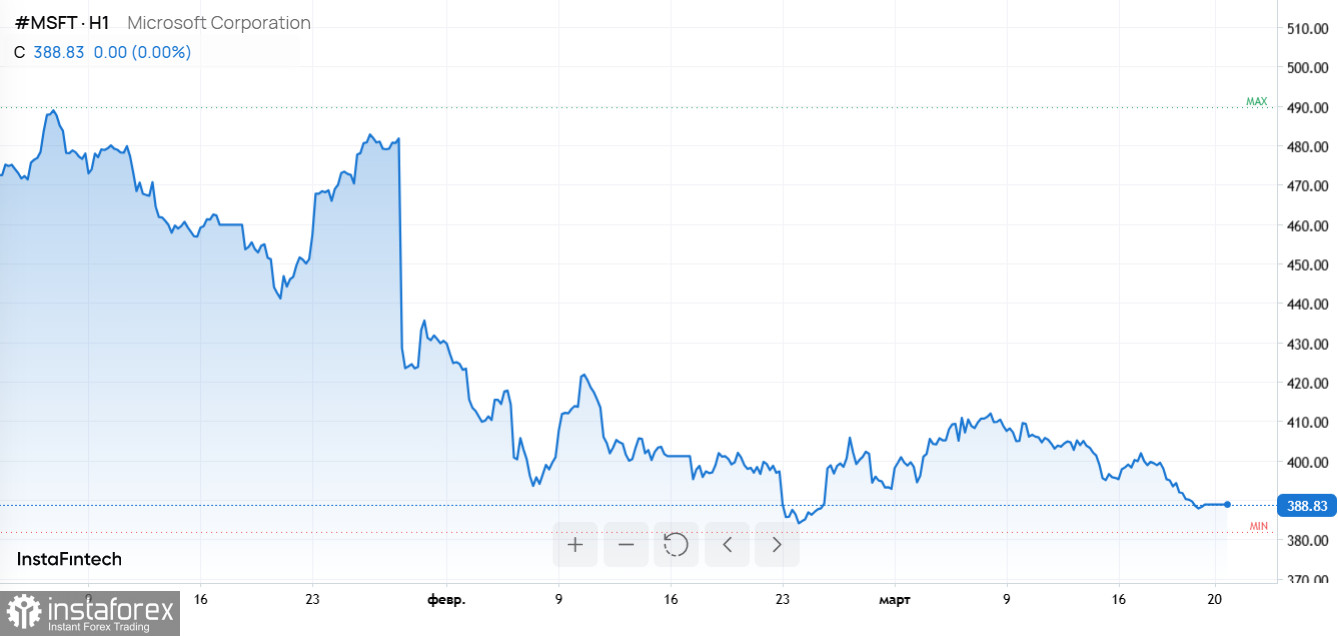
The MAI-Image-2 launch comes days after a leadership reshuffle in Microsoft AI. On Monday, Satya Nadella said Mustafa Suleyman would step back from a broader Microsoft AI CEO role to focus exclusively on the Superintelligence team and frontier-model development.
Meanwhile, former Snap executive Jacob Andreu was promoted to lead the combined Copilot organization. The moves underline Microsoft's corporate bet on accelerating development of cutting-edge AI products and deeply integrating them into its services.
The instruments mentioned are available on the InstaForex platform. To act quickly on MAI-Image-2 developments, open an InstaForex account and download the MobileTrader app to monitor quotes and manage positions in real time.
MobileTrader: platform dagangan di hujung jari!
Muat turun dan mulakan sekarang!
Anda telah pun menyukai siaran hari ini
* Analisis pasaran yang disiarkan di sini adalah bertujuan untuk meningkatkan kesedaran anda, tetapi tidak untuk memberi arahan untuk membuat perdagangan.
 Jika anda mempunyai sebarang soalan berkaitan kandungan, sila hubungi editorial-board@instaforex.com


